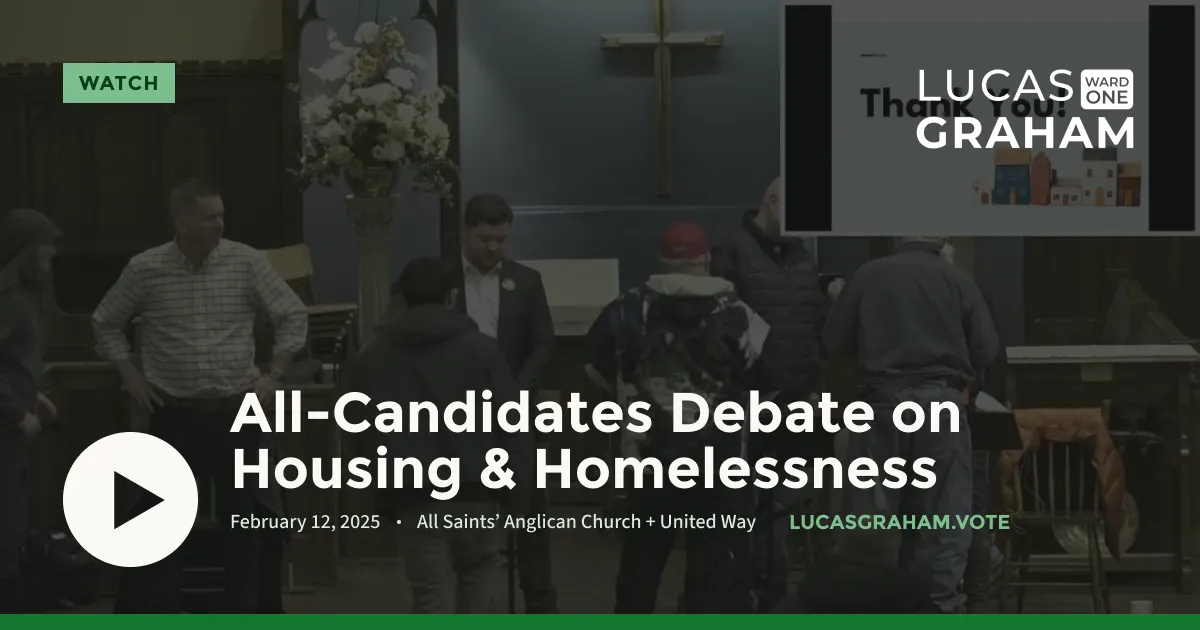
This debate was entirely focused on housing and homelessness, which made it one of the more substantive events of the campaign. I joined Jen Deck, Adam Hopkins and Andrew Roudny at All Saints’ Anglican Church to answer questions from organizers and people in the community.
The format gave us more time than most debates to get into the causes of homelessness, affordable housing, encampments, rent, supportive housing and the role the province should be playing.
Below is a time-stamped transcript of all of my answers to the questions covered during the debate.
First of all, I just wanted to thank the organizers quickly — Jim, Joelle, Alicia, Christian, everyone else who has been key in putting this together. My name is Lucas Graham. I’m the Green Party candidate for the upcoming provincial election.
Homelessness in Ontario has reached a crisis point, and the fact that it has increased by 25% in just three years is not a failure of individuals at all; it’s a failure of government policy. The primary causes, I think, are clear: skyrocketing housing costs, a severe shortage of affordable homes, and a lack of wraparound supports for mental health and addiction.
Instead of treating homelessness as a policing issue, we need to treat it as a housing and health-care issue. The Green Party’s plan directly tackles these root causes. First, we’re going to implement a Housing First approach, which means that housing is the first priority when helping people experiencing homelessness. We’ll immediately support those living in encampments rather than displacing them by providing them with temporary and permanent modular housing on provincial land. This model has worked in cities like Medicine Hat, Alberta, where they functionally ended chronic homelessness by prioritizing permanent housing over shelters.
The Green Party plan also includes building 250,000 affordable nonprofit and co-op homes and 60,000 permanent supportive-housing units, ensuring that those experiencing homelessness have access to stable, long-term housing with mental-health and addiction services attached.
Homelessness is not inevitable. It is the result of decades of bad housing policy, and the Green Party will take bold action to ensure that everyone in Ontario has a safe and stable place to call home.
Right now, Ontario’s social-assistance rates are so low that they are actively keeping people in poverty instead of helping them escape it. Ontario Works provides just $733 per month, and the Ontario Disability Support Program offers only $1,368 per month, far below the cost of rent, let alone food and other essentials. In real dollars, these rates have fallen dramatically, making it impossible for recipients to afford a basic standard of living.
The Green Party has a clear plan to fix this crisis. First, we will double Ontario Works and ODSP rates as a precursor — or a first step — to moving toward a full basic income, so that no one relying on social assistance is forced into homelessness or food insecurity. People should not have to choose between paying rent and eating, and I don’t think that’s a radical thing to say.
Second, we will end the clawbacks on earnings for OW and ODSP recipients so people can work without being punished for trying to improve their financial situation. Right now, a person on ODSP loses 75 cents for every dollar they earn over $1,000 per month, which discourages them from working. We need to support people, not trap them in poverty.
Third, we will push for a basic-income guarantee, a proven model that ensures no one falls below a livable income level. In the Ontario Basic Income Pilot, participants had better health outcomes, higher employment and greater stability. I could go on — there’s lots of positives — but the Ford government scrapped it. We know basic income works. There are international examples, and we will fight to bring it back.
So let’s be clear: poverty is a policy choice. The Green Party chooses to end it by raising social-assistance rates, removing barriers to work, and implementing basic income to give everyone dignity.
First of all, let’s be clear: tearing down encampments does nothing to solve homelessness. It just pushes people who already have nothing farther into crisis. The current approach of using police-enforced evictions does nothing to address the root causes of homelessness either, which are a lack of affordable housing and proper mental-health and addiction supports for those who need them.
The Green Party, as I touched on earlier, will take a Housing First approach, which means getting people into permanent, stable housing instead of criminalizing poverty. We’re going to immediately provide housing and supports for those living in encampments by deploying temporary and permanent modular housing on provincial land instead of just moving people from place to place.
If you’re familiar with PATH — I know some people are very familiar with PATH here — it’s kind of that concept, but with government support instead of the opposite.
We’re going to build 250,000 new affordable nonprofit and co-op homes, plus 60,000 permanent supportive-housing units with mental-health and addiction services attached and guaranteed, so people don’t just get housing but the help they need to stay housed. And we’re going to fund wraparound services like harm reduction, mental-health care and job training, because housing alone isn’t enough. We need to address the reasons people are ending up in encampments in the first place.
We know this approach works. In Medicine Hat, Alberta, as one nearby example, a Housing First model reduced homelessness by 75%. We can do the same here if we treat housing as a human right instead of a privilege for people who have money. No one chooses to live in an encampment. They’re a symptom of a broken system, and the Green Party’s plans will end this cycle by providing real, stable housing and supports.
Emergency shelters undoubtedly serve a very important role, but they are not a long-term solution. They were never designed to be a long-term solution to homelessness. The problem is that we keep adding more shelter beds because it’s a very definite thing that people can see — the numbers going up — instead of fixing the reason that people end up in shelters in the first place, which is a severe lack of affordable housing and proper supports.
The Green Party will take a balanced approach that meets immediate needs while investing in permanent solutions: expand emergency-shelter funding so no one is left in the cold, but we’re not just going to stop there. We will ensure every shelter has direct pathways to permanent housing and support services, because a shelter should be more of a stepping stone instead of an end destination.
We would also build 250,000 affordable nonprofit and co-op homes and 60,000 permanent supportive-housing units so people have a real alternative to shelters as they move along their journey and struggle with homelessness. Without enough permanent housing, shelters just become overflow spaces for a broken system, and that shouldn’t be the end of it.
We’re also going to fully fund wraparound services, including mental-health care, addiction treatment and job training, so people don’t just get housed but stay housed. Right now, shelters are overwhelmed because people cycle in and out without proper support.
This approach has worked in other countries and other provinces. I think Jen mentioned Finland; they had their Housing First model, which cut homelessness by 80% because they treated housing as the solution, not just emergency shelters. We need to stop treating homelessness as something to manage and start ending it with real solutions.
I’ll try to wrap up here quickly. I think a lot of the points have been touched on by some of my fellow candidates here.
I’ll start out with the statement: housing is a basic human right, and it’s not an investment opportunity for the wealthy. Right now, unfortunately, too much of Ontario’s housing is being bought up by corporate investors, turned into short-term rentals or flipped for profit, pricing everyday people out of both home ownership and the rental market.
The Green Party is proposing a clear, multipronged plan to protect and expand affordable housing so that people will pay no more than 30% of their income on rent or a mortgage. We’re going to give nonprofits the first right to buy rental buildings before corporate landlords can snap them up, keeping more housing in the hands of the community instead of investors.
We’ll implement a province-wide multiple-property speculation tax, starting at 25% on the third home and increasing with every additional property owned. This will curb investment-driven housing inflation and stop corporate landlords from outbidding families who just want a place to live.
We’re also going to reinstate and strengthen rent control, including vacancy control, so landlords can’t exploit loopholes to jack up rent when tenants leave.
Ontario’s housing crisis is the result of decades of bad policy where homes were treated as assets rather than places to live, and the Green Party will put housing back in the hands of people, not speculators, so that no one has to spend more than 30% of their income just to have a roof over their head.
I understand why people feel exhausted. There’s homelessness, addiction and the drug-poisoning crisis. They’re not just statistics; they are human tragedies playing out on our streets, in our communities and in the lives of people we actually know. When we see these crises grow worse year after year despite all the promises from politicians, it’s easy to feel hopeless. There’s a lot of hopeless news in the media right now, but we can’t afford to give up, because behind every statistic is a person who deserves dignity, deserves support and a chance to rebuild their life.
The Green Party believes that a strong community is one where no one is left behind, and here’s how we will lead with solutions that bring people together rather than divide us.
I’m going to reiterate the Housing First approach, because housing is the foundation for stability. When people have a home, they are far more likely to recover, to find employment and reconnect with their community. We will build 250,000 affordable homes and the 60,000 supportive-housing units so no one is forced to live on the streets.
We’re also going to treat addiction as a health issue and not a crime. That means expanding harm-reduction programs, safe supply and treatment options so people can get the care they need instead of being punished for their suffering.
This crisis won’t be solved by policing. It will be solved by health care and compassion and connection. I encountered a quote — I’m not sure where it came from right now — that the opposite of addiction isn’t sobriety; it is connection.
We’re also going to invest in mental-health services, community outreach and crisis-response teams, so that when someone is in distress they are met with support, not judgment. This is about more than just policy. It’s about building a province where we can take care of each other.
If you haven’t seen it, the GPO official platform book just came out today. It does have a section specifically about this topic, and the reason it has that under its Truth and Reconciliation header is because historically there are statistically worse outcomes and a more difficult situation for people who are Indigenous. One of those negative outcomes is an increased rate of being unhoused.
We would offer a lot of the same supports that I’ve been discussing earlier, but we’d do it in a collaborative way where we communicate with community Elders, community leaders, and always be listening and learning so that we can do something that works best for the community that we’re trying to serve.
The last time was about, let’s say, five days ago, I suppose, while I was out canvassing. Going door to door, talking to people who live in houses, it kind of occurred to me that that’s not a great practice. I was walking past someone who wasn’t doing anything, and in the same way that I knock on doors and try to get the attention of the homeowner, I just struck up a little conversation.
I will say that it’s not something that I’ve done often enough, and it was enlightening. There was a lot of apathy and feelings of disenfranchisement and hopelessness, and I imagine that that is consistent among a large group of our homeless here. I need to get more of their perspectives.
That’s a really interesting question, and thank you for it. I think it’s going to be a shorter list to talk about the housing initiatives that I don’t support, because as Jen said, any housing is good housing. It’s all contributing to easing the crisis that we’re in.
But there are certainly less efficient ways to do that. That would be luxury apartments; that would be sprawling endlessly into suburbia. I think intensification and working within the city limits — and not extending and overextending our utilities out into the middle of nowhere — are more productive uses of our time and money toward housing. I think that there are many more efficient uses of our time and money.
Thank you very much for your question. I’m actually really glad you asked it because it allows me to continue a little bit of my thoughts from the last one. I’m going to say density a few more times as well.
Intensification is really just building up, building more dense, making more efficient use of the land that we’ve already got zoned. That is oftentimes taken up by things like parking spots and parking minimums, which are not financially efficient and they are not good for the environment either.
I’ll just reiterate: I don’t believe in sprawling suburbs, because those are the things that eat up farmland. Everyone needs their single-family dwelling with their large yard — or they don’t need it; that’s what they are sold on. But the truth is you need to be in close proximity to services, you need to be in close proximity to grocery stores. So: intensification, density.
Great question. I have a question of my own: would you play a guitar with one string? You could probably do a decent job at it, but you’re not getting the full picture. You don’t have the full range of sound.
I think it’s the exact same with focusing on treatment-only models without harm reduction. Harm reduction keeps people alive. Safe-injection sites keep people alive. Dead people do not recover from their addictions.
I think we need a comprehensive approach. We need to have supports for people at all steps of their addiction journey and their journey to recovery, and just focusing on one support at the cost of the others is not a good solution.
Thank you for your question. I think there are a couple areas, with varying degrees of closeness, where we differ.
In terms of the New Blue, it sounds like we have fairly different approaches to certain issues. Again, we’re going toward the same goals by the sound of it, but we’re taking very different paths.
On the Liberal side, it sounds like we’re taking the same path but with varying degrees of strength, I guess. We’re pushing a little bit harder on some of the numbers, on some of the things where we have similar concepts that we are proposing, but our numbers — at least in the platform that we’ve produced — are a little bit farther.
With the NDP, it’s a little more subtle, but I think what sets us apart is that the environment is a part of the NDP platform, whereas it’s our core, and that is what all of the social and economic stuff is built on.
First of all, I’ll pre-empt by saying that no, I don’t agree with any of the stigmas or the stereotypes. I think the reason for that is because I know that anyone could become homeless. It’s not some feature of someone’s being; it’s just something that has happened to them.
Because we live in such an individualistic society, it’s scary to confront that, or acknowledge to ourselves that anyone can become homeless, because that means that we have to acknowledge that we could become homeless as well.
I think that’s why people put up barriers and create stigmas and create mental blocks for themselves, because they’ve got a measure of cognitive dissonance. They don’t want to acknowledge that they might become homeless just through a poor twist of luck.
Tonight we have talked about a lot of the challenges facing Ontario, facing Peterborough: housing, health care, in some aspects affordability and the rising cost of living. But this election isn’t just about the problems; it’s about who has the courage to take real action to fix them.
For too long, we’ve watched governments make promises and break them. We’ve seen housing prices soar while corporate landlords buy up homes and rents skyrocket beyond what people can afford. We’ve seen growing encampments in Peterborough while politicians respond with police crackdowns instead of permanent housing solutions. We’ve seen emergency rooms overwhelmed while governments cut services instead of investing in them.
And every election, we’re told to pick between the same parties and hope that this time things will be different. But hope isn’t a strategy, and we need action. If you always vote for the same parties, you’ll always get the same results.
The Green Party has real solutions: building the homes we need, putting an end to housing speculation, ensuring health care is fully funded and accessible, and making life more affordable — not by handing tax breaks to the wealthy, but by investing in people, real people.
A vote for change is never wasted. A vote for the same broken system is.
Some will say this kind of change isn’t possible, but I believe it is. And more importantly, I know that some of the people here, the people in Peterborough–Kawartha, believe that it’s possible as well. We’ve seen what happens when we come together as a community, as a province, as a country, and when we demand better, we make it happen.
So this election is a choice for you: do we accept more of the same, or do we fight for something better? If you’re ready for bold leadership that puts people first, I invite you to join us, and together we can build a future where every person has a safe, affordable place to call home.