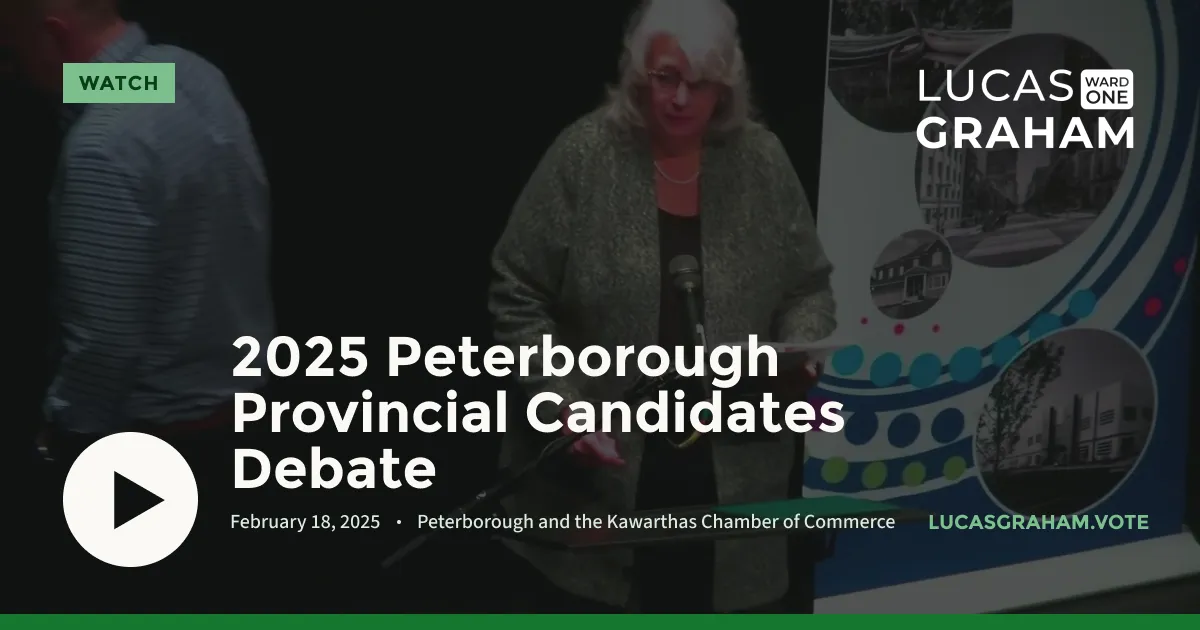

This was the main business-focused debate of the 2025 provincial campaign. I joined Jen Deck and incumbent MPP Dave Smith at Market Hall to answer questions from local business and community organizations.
The discussion went well beyond business alone, touching on housing, health care, municipal finances and the pressures people and local organizations were dealing with across Peterborough–Kawartha.
Below is a time-stamped transcript of all of my answers to the questions covered during the debate.
Thank you to the organizers for hosting this debate, and to everyone here tonight for taking part in this very important conversation about the future of Peterborough–Kawartha. My name is Lucas Graham. I’m your Green Party candidate, and I’m running to be your next MPP because I believe in fairness: a fair housing market, a fair economy, and a fair approach to development that supports both our communities and the businesses that build them.
For too long, we’ve had governments that pick winners and losers, giving handouts to massive developers while making it harder for small and midsized builders to get projects approved. We’ve seen a housing market that rewards speculators while shutting out first-time buyers, and we’ve seen small businesses struggle while corporate giants get tax breaks. That’s not fairness. That’s a system that’s rigged, and it’s time for a new approach.
The Green Party and I believe that a strong Peterborough–Kawartha is built on fairness. That means cutting red tape for the right kinds of development: homes people can actually afford, built in communities where people want to live. It means working with home builders and Realtors to speed up approvals and modernize zoning, while cracking down on corporate investors who treat our housing market like a stock exchange. It also means supporting small businesses and downtown revitalization, not just throwing money at sprawl and hoping for the best.
I bring a fresh perspective, but more importantly, I bring a commitment to balance. We can have a thriving housing market without sacrificing affordability. We can support businesses without prioritizing only the biggest players. We can create smart, sustainable growth that works for everyone, not just those with the most money or influence.
This election isn’t just about what we’re against; it’s about what we stand for. And if you’re ready to vote for a future where our businesses, our developers and our people thrive together fairly, then let’s make it happen.
I think the only way to approach this is with a short-term, mid-term and long-term plan.
In the short term, the Green Party is not afraid to work across party, jurisdictional and sectoral lines. We’re going to immediately create a tariff task force that works across those lines to negotiate with the United States on trade, to try to minimize the impact of these tariffs or hopefully entirely mitigate them by calming the guy down down there.
But that is only in the short term. In the mid- and long-term, we want to bring more of those manufacturing jobs and more of those raw-material imports back into our province. As the other candidates have said, we’re of course going to work with other provinces to finally remove interprovincial trade barriers.
In addition, we’re going to provide $2 billion per year for capital spending for municipalities to build resilient infrastructure through a dedicated climate-adaptation fund. We’re going to create a Protect Ontario Fund for businesses disproportionately impacted by tariffs, and make the investments needed to build new supply chains, either interprovincially or just in our local economy.
Finally, we’ll create an investment tax credit to unlock more business investment within Ontario.
This is a very multifaceted topic, but I think there are a couple different angles that we can come at it from.
First, we’re going to strengthen downtown businesses by cutting some of their costs. The Green Party will increase the Employer Health Tax exemption to $1.5 million, which will reduce costs for small businesses and make them more competitive. They can reinvest that in staff and growth.
We’re also dedicated to creating more transit, parking and accessibility so that downtowns are easier to access: expanding public transit and intercity connections in particular, and reducing downtown traffic congestion by investing in some road improvements.
We’ve also got some grants for small-business upgrades. Really, the core of the Green perspective on small business is that it makes up more than 90% of all employment in Canada — in Ontario as well — and so we need to support them by not giving more tax breaks and subsidies to large corporations, but actually creating incentives for entrepreneurship and creating more small businesses.
I think this is a two-parter. For the first part, I would say that there’s a large degree of red tape. I hear from builders all the time that they want to help, they want to build homes, but they don’t have the funding or the capacity to make it past that red tape.
First of all, we’re going to try to remove as much of that red tape as possible, particularly the red tape that is preventing affordable, proper housing from being built — but none of the red tape that’s protecting real people.
The other part of the slowdown is that there’s a lot of opportunity for creating sort of missing-middle housing: duplexes, fourplexes, low-rise apartment buildings. Those are zoned the same as these large luxury apartment buildings, but because they’re small, they’re not as competitive.
So we have either the option of big sprawling suburbs, or we have large luxury condos, but the types of homes that people want to build are locked away behind zoning laws. So we’ll change those.
I think the roots are clear. Even if more help is coming, there’s still not enough addiction care, not enough mental-health care, and not enough affordable housing.
We would propose immediately deploying — if you’re familiar with PATH, they’ve got those tiny homes — similar sorts of concepts, but using provincial land that’s not being used for anything, giving it out at no cost through a lease to nonprofits that are able to create those houses and get people into them.
Those are going to be guaranteed supportive houses. They’re going to have people on site who are able to provide addiction and mental-health care, because maybe we can’t solve it overnight, but overnight is what is important to people who are outside. You’ve all walked through the cold on the way in here. Overnight is very important. We need to do our best to address that.
Again, we need to take an immediate-term, a short-term and a long-term solution. We’re also trying to increase the number of doctors and expand the scope of care that’s able to be provided by local clinics to include addiction services, even physiotherapy and mental-health care.
We’re also going to say it’s on the way, but we have plans to address things immediately.
I think that we’ve identified a lot of the problems already: lack of affordability and too much red tape in the way of first-time home buyers.
Right off the bat, one of the things that we’re proposing is to end the land transfer tax for first-time home buyers to make it more affordable for people to purchase their first home. We’re going to require municipalities to permit developments using pre-approved building designs — starter-home designs — to allow for more affordable development.
We’re going to increase housing supply and help new homeowners pay down their mortgage by offering zero-interest loans of $225,000 for homeowners if they want to add affordable rental units onto their primary residence, like accessory dwelling units. So not only are we getting more people into rentable units, we’re also helping first-time home buyers pay down their mortgage.
Lastly, we’re going to make homes more affordable for home buyers by removing development charges on homes, condos and apartment units built under 2,000 square feet within urban boundaries. We’re also going to implement an Affordable Community Fund to reimburse municipalities for that lost revenue.
To me, that sounds like a win-win for first-time home buyers and for developers.
Employment lands need to have access to utilities and roads, and all of that requires upkeep and maintenance. So I guess my question is: we already had that, and we’re instead using it for large residential sprawl, when we have urban boundaries that we could be building within. We could be intensifying, creating more density.
Instead, under this government, we’ve decided to sprawl out and use up all that land and all that room that could have been employment land, could have been bringing in manufacturing opportunities.
The property taxes of those suburbs and the people who live there don’t necessarily cover the cost of the utilities and the roads when everything is spread out, because as it gets farther from the downtown core, it becomes more expensive to upkeep.
It’s not a great use of our dollars. It looks like housing, it seems like housing, but in terms of whether it’s the right housing decision, it’s not an economically viable one. So I’d say that we ate up a lot of our prime employment land.
I’m going to probably rattle off a couple of these. We, as the Greens, are the only party that has published a costed platform for this election, so that makes my job a little bit easier.
We are going to create an Ontario Foodbelt to permanently protect prime farmland from being lost to non-agricultural uses such as urban sprawl, highways and gravel mining.
We’re going to invest in local food hubs to support local farmers, supply chains and businesses, and provide tax incentives for local food and beverage manufacturers who decide to purchase their inputs from local farmers — from Ontario farmers — so that we keep that in sort of a circular economy and keep the money within our communities.
We’re going to support supply management and defend Ontario food and farmers in trade negotiations; eliminate property-tax penalties for farmers with small-scale, value-added production facilities on their farms, because right now there are tax penalties for farmers who want to add that extra building to be able to take their product from an input stage to something else on their farm.
Lastly, we’re going to promote training in specialty programs that focus on sustainable practices and soil health within agricultural schools and extension services, which will provide jobs that will keep farming viable and a good job to get into.
That’s a really good question. I think there are lots of different facets to the health-care situation.
First of all, we’re going to stop starving the beast. We’re not going to be cutting costs and cutting funding for health care, trying to push toward privatization. We’re going to immediately reverse all the Ford government’s pushes toward privatizing health care.
Really, the base of it is to get more doctors, get more nurse practitioners and get more personal support workers. But we also want to expand the scope of care that they are able to provide. Nurses at community clinics and personal support workers are going to be able to do things like mental-health and addiction care, physiotherapy.
We’re going to have those personal support workers working in ERs to take pressure off of the emergency teams at high-traffic times so that they are not overwhelmed.
We’re also going to do as much as we can to systematically reduce the overwhelming pressure on ERs by reducing the amount of paperwork that doctors have to do, and trying to spread everything a little bit more using community health clinics.
It’s been kind of a trend with the past 30 years of Liberal and Conservative governments to download things down the line to the municipalities, and frankly they don’t have the resources or the budget to handle everything like that.
One of the major things is the responsibility for housing and for getting people the care that they need if they’re unhoused. That would include addiction services and mental-health care. Those would be immediately re-uploaded to the provincial government, so that would free up some of the municipal government’s budgets.
Then they are going to be able to do what municipalities are supposed to do. They’re going to invest in infrastructure. They’re going to invest in making the community a brighter, more vibrant place. Right now they’re stretched very thin and they’re not able to do that because the provincial government has put a lot of pressure on them financially and in terms of responsibilities.
I guess what I’m going to finish off with is: we’re going to take charge, take responsibility for the responsibilities that have been put down on the municipalities, and re-upload them.
The Green Party is definitely in support of providing additional funding above and beyond what is being given to postsecondary institutions like Trent and Fleming.
As the question stated, they are the backbone of our growing economy. They’re the next generation that’s going to be taking over a lot of the jobs and starting ventures into entrepreneurship, and I think they should be supported.
Full disclosure, that is obviously my generation that I’m talking about. I’m clearly younger than the other candidates here, but I see that as a boon. I see that as an advantage because I can bring a fresh perspective.
If political experience was all it took to run a successful government, then I don’t think that we’d be in the situation we are right now. We’ve had 30 years of the Liberals and the Conservatives, and it’s not looking so good. I don’t think that we’d have a lot of the problems that we’re talking about here if that was the case.
Anyway, I digress. We would make it more attractive for students to stay in Peterborough once they graduate by supporting jobs, and we would take the burden off of their student loans by supporting them throughout.
I think the major one that I’m hearing at the doors is that we’ve got over 300 people who are permanently homeless right now in Peterborough. I think that is what we are going to tackle first, and that is the issue that I would bring to Queen’s Park.
We’ve already got a really great nonprofit program called PATH — Peterborough Action for Tiny Homes — and a big part of what the Green Party is proposing is making more of those types of units and putting them on provincial land that’s not being used for anything, allowing them to build more and immediately get people off the streets into these supportive houses with wraparound services, including addiction care and mental-health care.
From the perspective of downtown — I live in Town Ward — I want to make sure that people are able to have a warm, safe place to sleep at night. But it also cascades over into every other aspect of downtown, because we’ve got these tent cities. They are hurting businesses; they’re hurting people who are suffering under these poor conditions.
That’s going to be my number-one priority when I get to Queen’s Park.
<p>Tonight we’ve talked about a lot of the challenges facing Peterborough–Kawartha: housing, affordability, the future of our businesses and how we grow as a community. But this election isn’t just about the problems. It’s about the choice that we have to make.</p><p>For too long, Doug Ford’s Conservatives and the Liberals before them have put corporate profits ahead of real people. We’ve seen it in the housing market, where giant investors drive up prices while families are priced out. We’ve seen it in infrastructure spending, where highways and magic tunnels are prioritized over local roads and transit. And we’ve seen it in small-business policies that offer handouts to corporate chains while independent businesses struggle.</p><p>We can’t afford another four years of this broken system, and we can’t afford to keep voting the same way and expecting a different result.</p><p>Some are going to tell you that you should vote strategically, but let’s be honest: if strategic voting worked, we wouldn’t be in this mess. The only thing the lesser-of-two-evils approach has given us is rising costs, a worsening housing crisis, and politicians who serve donors over people. It’s time to vote based on your values and not your fears.</p><p>The Green Party has real, practical and costed solutions to build homes people can afford, revitalize our downtown areas, support businesses and developers who play fair, and invest in infrastructure that benefits everyone, not just the highest bidder.</p><p>And while other parties make big promises, we’ve done the work. We’re the only party to release a fully costed platform, so voters know exactly how we’ll pay for our commitments without hidden cuts or vague numbers.</p><p>This election, I ask you to vote for what you truly believe in — not out of fear, not for the same old broken promises, but because you know that we as a community can do better.</p><p>Together, we can build a strong, fair and thriving Peterborough–Kawartha. Let’s make it happen.</p>